








VOS3000 SIP Call Flow Explained – Routing, Gateway and Carrier Process
VOS3000 is one of the most widely used VoIP softswitch platforms for wholesale VoIP operators. It provides a powerful routing engine, carrier gateway management and billing control for telecom operators.
Understanding the VOS3000 SIP call flow is very important for network engineers and VoIP operators because it explains how calls travel from a SIP client or gateway through the routing engine and finally to a carrier network.
This article explains the complete call flow inside the VOS3000 system including SIP signaling, authentication, routing decisions and gateway selection.
📱 WhatsApp Support
+8801911119966
Table of Contents
Overview of VOS3000 Softswitch
VOS3000 is a carrier grade VoIP softswitch platform designed to manage large volumes of telecom traffic. The system allows operators to connect multiple vendors, clients and gateways while controlling call routing through prefix based rules.
The platform includes several major components such as:
- SIP signaling server
- routing engine
- gateway management
- billing system
- traffic monitoring
You can find official software and manuals here:
VOS3000 Official Downloads and Manuals
Client software for different VOS3000 versions is also available here:
VOS3000 Client Download Center
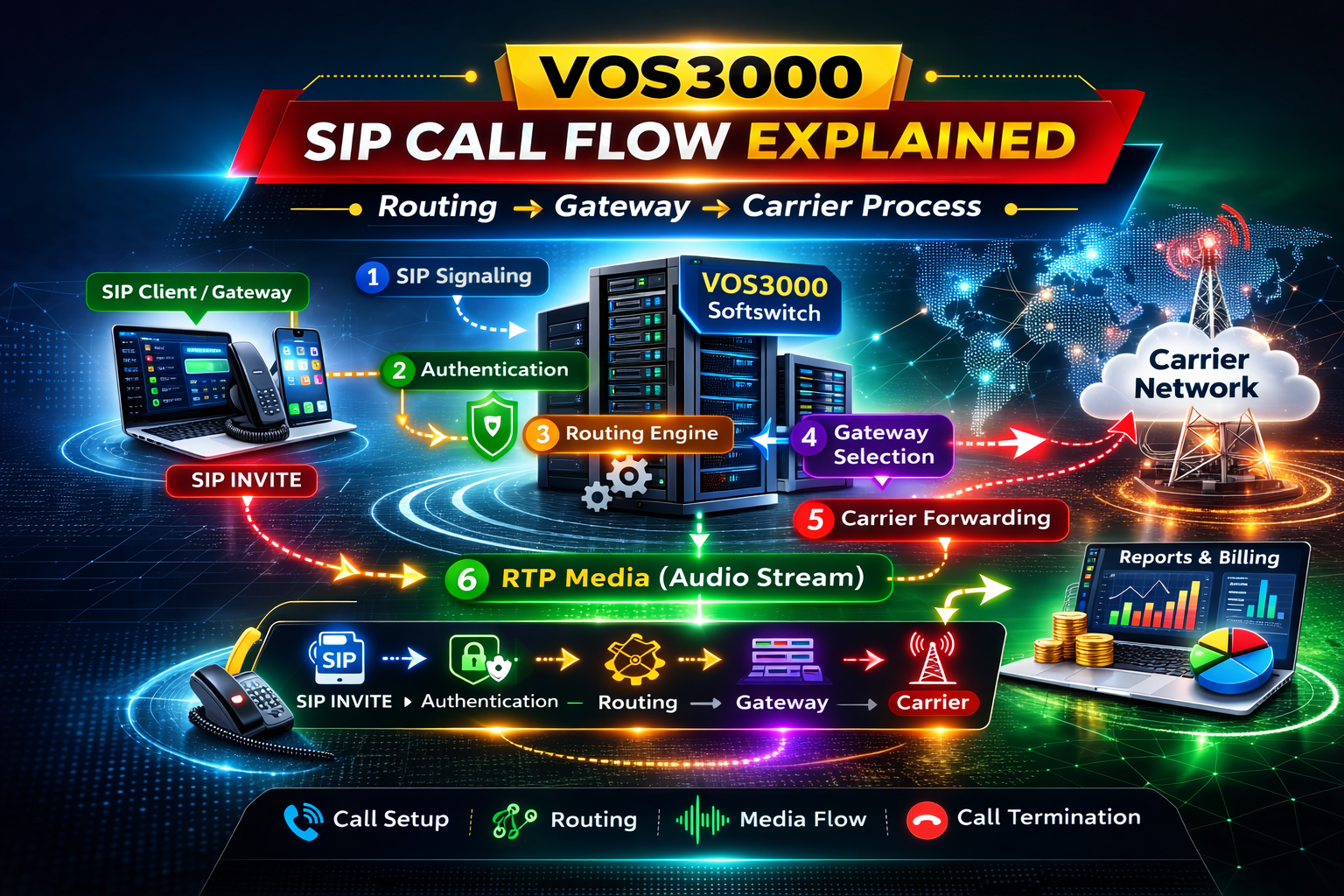
Basic SIP Call Flow in VOS3000
When a VoIP call enters the VOS3000 softswitch, the system processes the call through several stages before sending it to a telecom carrier.
The simplified call flow looks like this:
- SIP INVITE request received
- Authentication and account validation
- Prefix analysis and routing decision
- Gateway selection
- Call forwarded to carrier
- RTP media established between endpoints
Each of these steps is handled by the VOS3000 routing engine.
SIP INVITE and Signaling Processing (VOS3000 SIP Call Flow)
The SIP call process begins when a SIP device, gateway or VoIP system sends an SIP INVITE request to the VOS3000 server.
This SIP request includes information such as:
- caller ID
- destination number
- SIP authentication data
- codec negotiation details
Once the INVITE request reaches the softswitch, the system verifies whether the source account or gateway is allowed to originate calls.
Authentication and Account Validation
After receiving the SIP request, VOS3000 verifies the sender using authentication or IP based authorization.
Common verification methods include:
- SIP username and password
- IP authentication
- gateway authorization
If the system confirms the account is valid, the call proceeds to the routing stage.
Routing Engine and Prefix Analysis
The VOS3000 routing engine analyzes the dialed number to determine which route should be used.
This is usually based on the destination prefix.
For example:
- 1 → United States
- 44 → United Kingdom
- 880 → Bangladesh
Routing rules define which carriers should handle these prefixes.
Detailed routing configuration is explained here:
VOS3000 Routing Guide – Prefix and LCR Routing
Gateway Selection
Once a route is matched, VOS3000 selects a gateway associated with that routing rule.
A gateway represents a connection to a telecom carrier or VoIP provider.
Gateway configuration normally includes:
- carrier IP address
- SIP port
- transport protocol
- authentication parameters
After selecting a gateway, the softswitch forwards the SIP INVITE request to the carrier.
You can learn more about trunk configuration here:
VOS3000 SIP Trunk Configuration Guide
Carrier Call Processing
After receiving the SIP INVITE, the telecom carrier processes the call and attempts to connect the destination number.
If the destination answers, the carrier returns a 200 OK response back to the VOS3000 system.
The softswitch then sends the response back to the originating client.
RTP Media Flow (VOS3000 SIP Call Flow)
After the call is successfully connected, RTP media streams carry the voice packets between the endpoints.
Depending on network configuration, RTP may flow:
- directly between endpoints
- through media servers
- through gateway devices
Proper codec negotiation and firewall configuration are important to ensure stable audio quality.
Call Monitoring and Reports
VOS3000 provides detailed traffic monitoring tools which allow operators to track call statistics.
Important metrics include:
- ASR (Answer Seizure Ratio)
- ACD (Average Call Duration)
- CPS (Calls Per Second)
- gateway traffic reports
These statistics help operators optimize routing and carrier performance.
More information about traffic analysis is available here:
VOS3000 Error Codes and Troubleshooting
Why Understanding Call Flow is Important (VOS3000 SIP Call Flow)
For VoIP operators, understanding the call routing process is critical for diagnosing issues such as:
- call failures
- routing errors
- carrier rejection
- billing discrepancies
By understanding the VOS3000 call flow, operators can quickly identify which stage of the process is causing the problem.
FAQ – VOS3000 SIP Call Flow
What is SIP call flow in VOS3000?
SIP call flow refers to the sequence of processes inside the VOS3000 softswitch that handles SIP signaling, routing and gateway forwarding for VoIP calls.
How does VOS3000 select a carrier?
The system uses routing rules based on number prefixes and gateway priorities to select the appropriate carrier.
Does VOS3000 support multiple gateways?
Yes. Multiple gateways can be configured to connect several carriers and provide failover routing.
Where can I download VOS3000 manuals?
Need VOS3000 Hosting or Deployment?
If you need VOS3000 hosting, server deployment or routing configuration assistance, you can contact us.
📞 Need Call Center Setup Support?
For professional VOS3000 call center configuration and deployment:
📱 WhatsApp: +8801911119966
🌐 Website: www.vos3000.com
🌐 Blog: multahost.com/blog
📥 Downloads: VOS3000 Downloads
 | | |