








VOS3000 Login Brute-Force Lockout: Essential Failed Disable Time
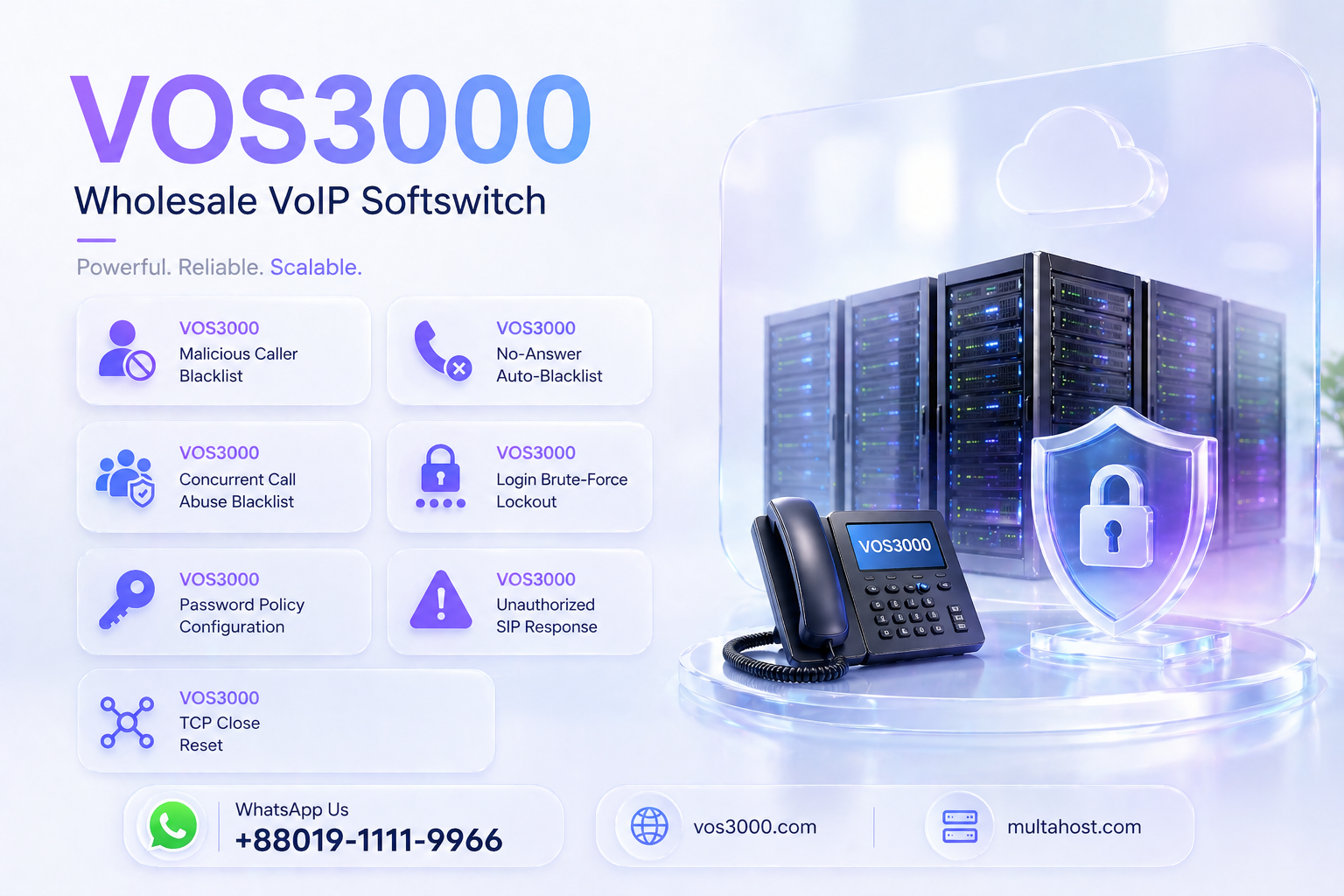
🔐 Your VOS3000 softswitch is only as secure as the login protecting it. Without a VOS3000 login brute-force lockout mechanism, attackers can run automated dictionary attacks against the VOS3000 client and web manager interface, testing thousands of password combinations until they find a valid one. The SERVER_LOGIN_FAILED_DISABLE_TIME parameter provides essential protection by locking accounts after repeated failed login attempts, rendering brute-force attacks impractical and keeping your VoIP infrastructure secure. 🛡️
⚙️ The VOS3000 login brute-force lockout works by tracking failed login attempts for each account. When the number of consecutive failures exceeds the system threshold, VOS3000 disables the account for the duration specified by SERVER_LOGIN_FAILED_DISABLE_TIME. During this lockout period, no further login attempts are accepted — even with the correct password. This forces attackers to wait out the lockout between attempts, making dictionary attacks computationally infeasible. Combined with a strong VOS3000 security posture, this feature is your first line of defense against unauthorized access. 🔧
🎯 This guide covers SERVER_LOGIN_FAILED_DISABLE_TIME from the VOS3000 2.1.9.07 manual §4.3.5.1, including its default value, configuration range, how it interacts with password policy settings, and recommended values for different security requirements. Need help hardening your VOS3000 deployment? WhatsApp us at +8801911119966 for professional security configuration. 📞
Table of Contents
🔐 What Is VOS3000 Login Brute-Force Lockout?
⏱️ The VOS3000 login brute-force lockout is an account security mechanism that automatically disables user accounts after a specified number of consecutive failed login attempts. According to the official VOS3000 2.1.9.07 manual §4.3.5.1, this protection is controlled by the SERVER_LOGIN_FAILED_DISABLE_TIME parameter, which defines how long the account remains locked after the failed attempt threshold is exceeded. The lockout applies to both the VOS3000 Java client and the web management interface, providing comprehensive protection across all access points. 📞
💡 Why brute-force lockout matters: The VOS3000 client and web manager are exposed to network access by operational necessity. Without lockout protection, an attacker with network access can automate login attempts using common password dictionaries, testing hundreds of combinations per minute. With lockout enabled, each failed attempt sequence results in a timeout period that must expire before another attempt can be made. A 120-second lockout means an attacker testing a 10,000-word dictionary would need over 16 days of continuous attempts, making the attack entirely impractical.
- 📡 Tracks consecutive failed login attempts per account
- 🔄 Disables the account for the configured lockout duration
- 📊 Applies to both VOS3000 client and web manager interfaces
- 🛡️ Makes dictionary attacks computationally infeasible
- 🎯 Works alongside password policy for defense-in-depth
📍 Location in VOS3000 Client: Operation management → Server management → Additional settings → Server parameter
📋 Brute-Force Attack Vectors in VOS3000
🌐 Understanding the attack vectors helps you configure appropriate protection:
| Attack Vector | Port | Risk Level | Protected By Lockout |
|---|---|---|---|
| 🖥️ VOS3000 Java Client | Multiple (configurable) | 🔴 High | ✅ Yes |
| 🌐 Web Manager (8080) | 8080 (default) | 🔴 High | ✅ Yes |
| 📡 SIP Registration | 5060/5062 | 🟡 Medium | ⚠️ Separate mechanism (SS_AUTHENTICATION) |
| 🔧 SSH Access | 22 | 🔴 High | ❌ No (use OS-level fail2ban) |
🔑 Important note: The VOS3000 login brute-force lockout protects the VOS3000 application layer only. SSH access to the underlying server is not protected by this mechanism and requires OS-level tools like fail2ban or iptables configuration. Always protect both layers for comprehensive security.
⚙️ SERVER_LOGIN_FAILED_DISABLE_TIME — The Core Parameter
🔧 This parameter is the sole control for the VOS3000 login brute-force lockout feature, documented in the official VOS3000 2.1.9.07 manual §4.3.5.1:
| Attribute | Value |
|---|---|
| 📌 Parameter Name | SERVER_LOGIN_FAILED_DISABLE_TIME |
| 🔢 Default Value | 120 |
| 📐 Unit | Seconds |
| 📏 Range | 30-7200 |
| 📝 Description | Time of disable user login when failed several times |
💡 How the 120-second default works: When a user account experiences the threshold number of consecutive failed login attempts, VOS3000 disables that account for 120 seconds (2 minutes). During this period, all login attempts for that account are rejected — even with the correct password. After the 120 seconds expire, the account is automatically re-enabled and the failed attempt counter resets. The user can then attempt to log in again.
📋 How Lockout Duration Affects Attack Resistance
| Lockout Duration | Time to Test 10,000 Passwords | Security Level | Impact on Legitimate Users |
|---|---|---|---|
| 30 seconds | ~4 days | 🟡 Moderate | Low — short inconvenience |
| 120 seconds (default) | ~16 days | ✅ Good | Low — 2-minute wait |
| 600 seconds | ~80 days | 🟢 Strong | Moderate — 10-minute wait |
| 3600 seconds | ~480 days | 🔴 Very Strong | High — 1-hour lockout |
🔑 Key insight: The VOS3000 login brute-force lockout duration directly controls how long an attacker must wait between each set of attempts. Longer durations provide exponentially better protection but create more inconvenience for legitimate users who mistype their passwords. The default of 120 seconds provides a solid balance — long enough to make attacks impractical but short enough that a legitimate user who triggers the lockout only waits 2 minutes.
🖥️ How the VOS3000 Login Brute-Force Lockout Works
🔄 Understanding the complete lockout flow helps you configure the right settings and troubleshoot issues:
🔐 VOS3000 Login Brute-Force Lockout Flow:

User attempts login to VOS3000 Client or Web Manager
    │
    ├── Login FAILED (wrong password)
    │   │
    │   ├── Increment failed login counter for this account
    │   │
    │   ├── Check: Has failed count exceeded threshold?
    │   │   │
    │   │   ├── No  →  ✅ Allow next login attempt
    │   │   │
    │   │   └── Yes →  🔴 ACCOUNT LOCKED!
    │   │       │
    │   │       ├── Disable account for
    │   │       │   SERVER_LOGIN_FAILED_DISABLE_TIME
    │   │       │   (default: 120 seconds)
    │   │       │
    │   │       ├── All login attempts rejected
    │   │       │   during lockout (even correct password)
    │   │       │
    │   │       └── After lockout expires:
    │   │           └── Reset failed counter
    │   │           └── Account re-enabled
    │   │
    │   └── Login SUCCEEDED
    │       └── Reset failed login counter
    │       └── ✅ Normal access granted
    │
    └── 📊 Lockout events logged in system audit
📋 Step-by-Step VOS3000 Login Brute-Force Lockout Configuration
Step 1: Access Server Parameters 🌐
- 🔐 Log in to VOS3000 Client with admin credentials
- 📌 Navigate: Operation management → Server management → Additional settings → Server parameter
- 🔍 Locate SERVER_LOGIN_FAILED_DISABLE_TIME in the parameter list
Step 2: Configure Lockout Duration ⏱️
- ✏️ Set the value in seconds within the range 30-7200
- 💡 For most deployments, 120-600 seconds provides excellent protection
- 💾 Save the configuration
Step 3: Configure Password Policy (Complementary) 🎯
- 📝 Configure SERVER_PASSWORD_LENGTH for minimum password length (default: 8)
- 📝 Configure SERVER_TERMINAL_ADDITIONAL_CHARACTERS for allowed special characters
- 💡 Strong passwords + lockout = comprehensive login protection
Step 4: Test Lockout Functionality 🔍
- 🔧 Intentionally trigger lockout by entering wrong passwords for a test account
- 📊 Verify the account is disabled for the configured duration
- 📞 Confirm the account automatically re-enables after the lockout expires
🛡️ Common VOS3000 Login Brute-Force Lockout Problems and Solutions
❌ Problem 1: Administrator Account Locked Out
🔍 Symptom: The admin user cannot log in even with the correct password after multiple failed attempts.
💡 Cause: The brute-force lockout has been triggered for the admin account, either by an attacker or by the administrator mistyping the password.
✅ Solutions:
- 🔧 Wait for the lockout duration to expire (default: 120 seconds)
- 📊 If you cannot wait, use the server-side mysql console to reset the lockout
- 📞 Always create a backup admin account to avoid complete lockout — see our security hardening guide
❌ Problem 2: Lockout Duration Too Short for High-Security Requirements
🔍 Symptom: Attackers can still make progress on dictionary attacks despite the lockout, because 120 seconds is not a sufficient delay.
💡 Cause: The default lockout of 120 seconds, while adequate for most deployments, may be insufficient for environments facing targeted attacks.
✅ Solutions:
- 🔧 Increase SERVER_LOGIN_FAILED_DISABLE_TIME to 600-3600 seconds for high-security environments
- 📊 Combine with strong password policies (12+ characters, mixed case, special characters)
- 📞 Implement network-level protections to block attack sources at the firewall
❌ Problem 3: Users Frequently Locked Out After Password Changes
🔍 Symptom: After mandatory password changes, users are frequently getting locked out because they accidentally type their old password.
💡 Cause: Users who recently changed their passwords may instinctively type the old password multiple times before remembering the new one.
✅ Solutions:
- 🔧 Consider a moderate lockout duration (120-300 seconds) that protects without excessive user frustration
- 📊 Implement a password change procedure that requires immediate re-login to confirm the new password
- 📞 Train users on the lockout mechanism so they stop attempting after 2-3 failures
💡 VOS3000 Login Brute-Force Lockout Best Practices
| Best Practice | Recommendation | Reason |
|---|---|---|
| 📊 Use minimum 120s lockout | Never reduce below the default 120 seconds | ✅ Default provides good attack resistance |
| 🔧 Create backup admin accounts | Always have a second admin account for emergencies | 🛡️ Prevents complete lockout of management access |
| 📋 Combine with password policy | Enforce 8+ character passwords with complexity | 📞 Strong passwords + lockout = defense-in-depth |
| 🔄 Increase for public-facing systems | Use 600-3600s when web manager is internet-accessible | 🔧 Higher exposure requires stronger protection |
| 📈 Monitor login failures | Regularly audit failed login attempts | 🔍 Detects attack patterns before they succeed |
| ⚠️ Protect SSH separately | Use fail2ban for SSH brute-force protection | 🛡️ VOS3000 lockout does not cover SSH access |
💡 Pro tip: The VOS3000 login brute-force lockout is most effective when combined with a strong password policy. If your passwords are only 6 characters of lowercase letters (about 308 million combinations), even with a 120-second lockout, a determined attacker with enough time could eventually succeed. But with 12-character passwords including mixed case, numbers, and special characters (trillions of combinations), the lockout makes attacks effectively impossible. For comprehensive protection, see our anti-hack guide. WhatsApp us at +8801911119966 for expert security assistance. 🔧
❓ Frequently Asked Questions
❓ What is the VOS3000 login brute-force lockout?
⏱️ The VOS3000 login brute-force lockout is an account security mechanism controlled by the SERVER_LOGIN_FAILED_DISABLE_TIME parameter that automatically disables user accounts after repeated failed login attempts. When the failed attempt threshold is exceeded, the account is locked for the configured duration (default: 120 seconds, range: 30-7200 seconds). During the lockout period, no login attempts are accepted — even with the correct password. This feature protects both the VOS3000 Java client and the web management interface from dictionary and brute-force attacks. It is documented in the VOS3000 2.1.9.07 manual §4.3.5.1.
❓ What is the default lockout duration in VOS3000?
🔧 The default VOS3000 login brute-force lockout duration is 120 seconds (2 minutes), configured via SERVER_LOGIN_FAILED_DISABLE_TIME. This means that after the failed login threshold is exceeded, the account remains locked for 2 minutes before automatically re-enabling. The configurable range is 30 to 7200 seconds, allowing you to adjust the duration based on your security requirements — shorter for convenience in low-risk environments, longer for stronger protection in high-risk deployments.
❓ Does the lockout apply to the web manager interface?
🌐 Yes, the VOS3000 login brute-force lockout applies to both the VOS3000 Java client and the web management interface. Any failed login attempt through either interface increments the failed attempt counter for the targeted account. This is especially important because the web manager (typically on port 8080) is more exposed to network-based attacks than the Java client, which often runs on a restricted management network. Ensure your web manager is properly secured alongside the lockout configuration.
❓ Can I unlock an account before the lockout expires?
📊 In the VOS3000 client, you cannot manually unlock an account before the lockout duration expires through the GUI. The account will automatically re-enable after the SERVER_LOGIN_FAILED_DISABLE_TIME period passes. However, in emergency situations where an administrator is locked out, you may be able to reset the lockout state through the server-side MySQL database directly. Always maintain a backup administrator account to avoid complete management lockout. For detailed recovery procedures, refer to our VOS3000 hack prevention guide.
❓ What lockout duration should I set for a public-facing deployment?
🛡️ For public-facing VOS3000 deployments where the web manager or client is accessible from the internet, we recommend setting SERVER_LOGIN_FAILED_DISABLE_TIME to at least 600 seconds (10 minutes), and ideally 3600 seconds (1 hour). Internet-facing systems are prime targets for automated brute-force tools, and a 120-second lockout provides only moderate protection against determined attackers. Combined with strong password policies and extended firewall rules, a longer lockout duration creates a robust defense against unauthorized access attempts.
❓ How does the login lockout interact with the SIP authentication retry limit?
📋 The VOS3000 login brute-force lockout (SERVER_LOGIN_FAILED_DISABLE_TIME) and the SIP authentication retry limit (SS_AUTHENTICATION_MAX_RETRY) are separate security mechanisms that protect different access points. The login lockout protects management access to the VOS3000 client and web manager. The SIP authentication retry limit protects SIP-level access for call setup and registration. Both should be configured together for comprehensive protection — securing management access alone does not prevent attackers from exploiting SIP authentication weaknesses, and vice versa. For the complete SIP authentication guide, see our detailed reference. WhatsApp us at +8801911119966 for expert help. 📞
📞 Need Expert Help with VOS3000 Login Brute-Force Lockout?
🔧 Proper VOS3000 login brute-force lockout configuration is essential for preventing unauthorized access to your softswitch management interface. Whether you need help setting lockout durations, implementing password policies, or building a comprehensive security hardening plan, our team is ready to assist. Reach us on WhatsApp at +8801911119966 for professional VOS3000 security configuration services. 📞
📞 Need Professional VOS3000 Setup Support?
For professional VOS3000 installations and deployment, VOS3000 Server Rental Solution:
📱 WhatsApp: +8801911119966
🌐 Website: www.vos3000.com
🌐 Blog: multahost.com/blog
📥 Downloads: VOS3000 Downloads
 | | |