
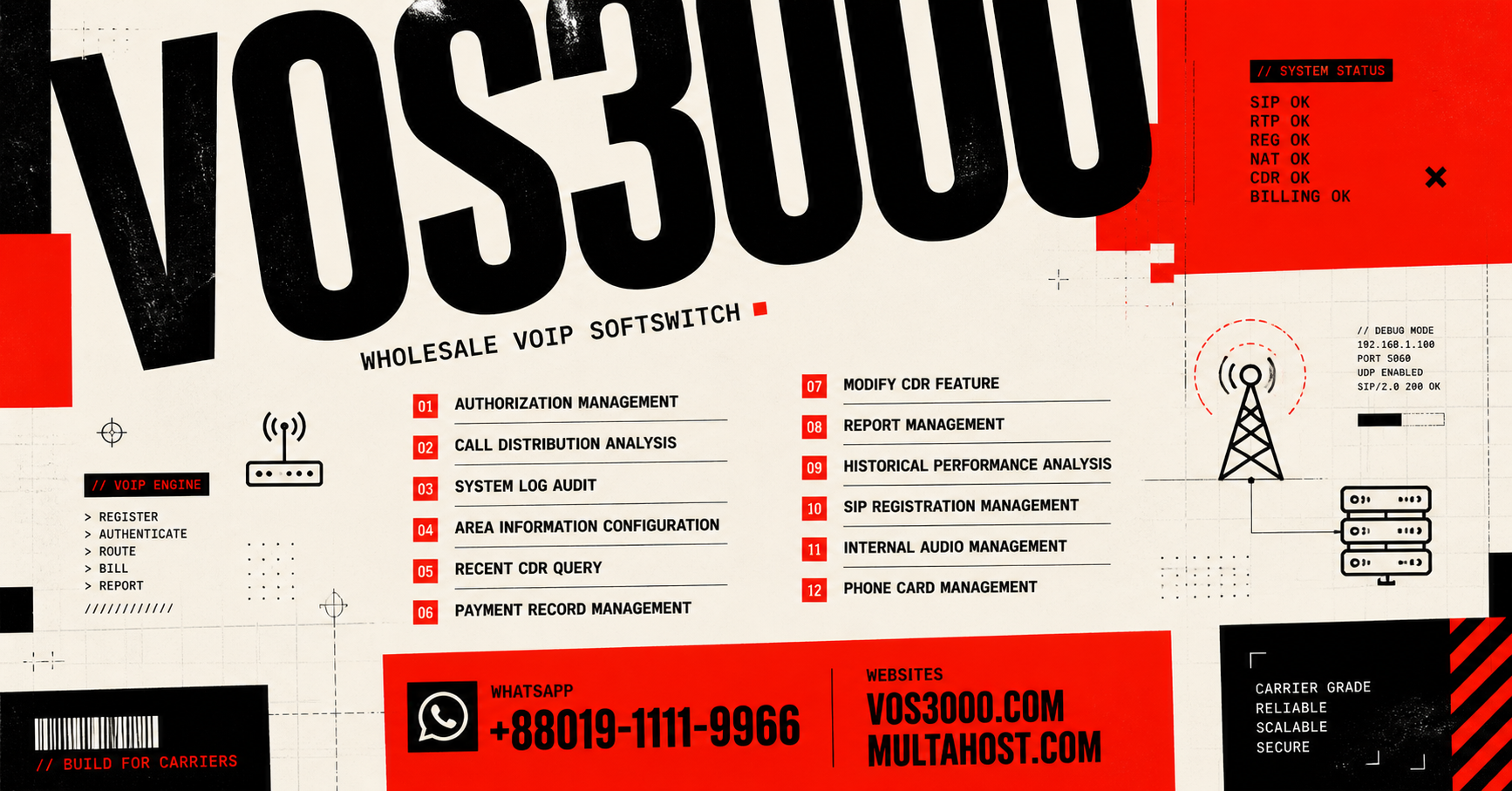
VOS3000 Area Information Configuration: Complete Destination Code Setup Best Guide
🌍 How does VOS3000 know that +1 is the USA, +44 is the UK, or that 92 is Pakistan? The VOS3000 area information configuration module provides the geographic numbering framework that underpins the entire routing, rating, and reporting system. Without properly configured area information, calls cannot be matched to the correct rates, routes, or destinations. 🔧
⚙️ According to the official VOS3000 V2.1.9.07 Manual, Section 2.13.2 (Area Information), this module manages destination codes, country prefixes, area definitions, and the relationships between them. The VOS3000 area information configuration forms the foundation of destination-based billing, LCR (Least Cost Routing), and traffic analytics. 📊
🎯 This guide covers the complete VOS3000 area information configuration system: area definitions, prefix management, country codes, configuration procedures, and integration with rate tables and routing. For expert VOS3000 configuration assistance, contact us on WhatsApp at +8801911119966. 📱
Table of Contents
🔐 Overview of VOS3000 Area Information Configuration
📞 The VOS3000 area information configuration is the geographic reference database that maps telephone number prefixes to destinations. When a call arrives, VOS3000 analyzes the dialed number, matches it against the area information database, and determines the destination country/area for routing and rating purposes. 💡
🌐 Key components of VOS3000 area information configuration:
- 🌍 Country Codes: International dialing codes (e.g., 1=USA, 44=UK, 91=India)
- 📍 Area Codes: National destination codes within countries
- 📞 Prefixes: Complete dialing prefixes including country + area code
- 📊 Area Groups: Logical groupings of destinations for rate/routing
- 💰 Rate Zones: Pricing classifications linked to areas
| Hierarchy Level | Example | Purpose |
|---|---|---|
| 🌍 Country | 1 (USA/Canada) | Top-level geographic classification |
| 📍 Area/Region | 212 (New York) | Regional subdivision for routing |
| 📞 Full Prefix | 1212 (USA-New York) | Precise destination for rate matching |
| 📊 Area Group | “North America” | Logical grouping for simplified management |
⚙️ Step-by-Step VOS3000 Area Information Configuration
🔧 Configuring area information in VOS3000 follows these steps:
Step 1: Navigate to Area Information 📡
- 🔐 Log in to VOS3000 Client with administrator credentials
- 📌 Navigate to: Basic Information → Area Information
- 🔍 The Area Information management interface appears
Step 2: Add or Edit Area Entries 📋
| Field | Description | Example |
|---|---|---|
| 📞 Prefix | The dialing prefix | 92 (Pakistan) |
| 🌍 Country | Associated country | Pakistan |
| 📍 Area Name | Descriptive area name | Pakistan-Mobile |
| 📊 Area Group | Logical grouping | South Asia |
| 💰 Rate Zone | Pricing classification | Zone_3 |
Step 3: Configure Area Groups 📊
📋 Area groups simplify management by grouping related destinations:
- 🌍 Continental Groups: Europe, Asia, Africa, Americas
- 💰 Pricing Tiers: Premium, Standard, Economy
- 📡 Routing Groups: Routes sharing the same carriers
- 🏢 Business Groups: Destinations for specific customers
📊 Common Area Configuration Scenarios
| Scenario | Configuration | Result |
|---|---|---|
| 🌍 Add New Country | Add country code prefix with area group | Routing and rating available for new destination |
| 📍 Split Existing Area | Create sub-prefixes for mobile vs fixed | Different rates for mobile and fixed lines |
| 📊 Merge Areas | Assign same area group to multiple prefixes | Single rate/routing for grouped destinations |
| 💰 Rate Zone Update | Change rate zone assignment | New pricing applied to all matching prefixes |
🔄 Bulk Import and Export of VOS3000 Area Information
📥 For operators configuring VOS3000 for international VoIP traffic, manually entering hundreds of area codes is impractical. The VOS3000 area information configuration module supports bulk import and export operations that dramatically speed up the initial setup process. Operators can prepare an Excel or CSV file containing all required area entries — with columns for prefix, country, area name, area group, and rate zone — and import the entire file in one operation.
This bulk import capability is essential when deploying VOS3000 for the first time, as a typical international wholesale operator needs 500-2000 area prefix entries to cover all major destinations worldwide. Before importing, always verify the data format matches VOS3000 expectations, and create a backup of existing area data in case the import produces unexpected results. The export function is equally useful for creating backups or transferring area configuration between VOS3000 instances during system migration. 💾
📊 Bulk import file format for area information:
| Column | Required | Description | Example |
|---|---|---|---|
| 📞 Prefix | Yes | Dialing prefix for destination matching | 92 |
| 🌍 Country | Yes | Country name for the prefix | Pakistan |
| 📍 Area Name | Yes | Descriptive name for the area | Pakistan – Mobile |
| 📊 Area Group | No | Logical grouping for routing/rating | South Asia |
| 💰 Rate Zone | No | Pricing classification | Zone_3 |
📐 Area Information and LCR Integration
🔄 The VOS3000 area information configuration is deeply integrated with the Least Cost Routing (LCR) system. When a call arrives, VOS3000 performs a longest-prefix-match lookup against the area information database to determine the destination. This destination is then used to look up applicable routes from the routing gateway configuration. The LCR algorithm considers the cost (from the rate table), quality (from historical ASR/ACD data), and priority settings to select the optimal route for each call.
Without properly configured area information, the LCR system cannot function correctly — calls to unmatched prefixes will fail to find routes and be rejected. This is why area information configuration is often described as the “foundation” of the entire VOS3000 routing and billing system. Every rate entry, every route, and every report depends on accurate area prefix definitions. 📊
💡 How area information flows through the VOS3000 call processing pipeline:
- 📞 Incoming call arrives with dialed destination number
- 🔍 VOS3000 performs longest-prefix-match against area information database
- 🌍 Area lookup determines the destination country, area name, and rate zone
- 💰 Rate table lookup uses the area prefix to find applicable rates
- 📡 Route selection uses the area group to find available routing gateways
- 🔄 LCR algorithm ranks routes by cost, quality, and priority
- 📞 Call is routed through the optimal gateway
- 📊 CDR records the area information for reporting and analytics
⚠️ Common Area Configuration Mistakes
🔧 Misconfigured area information causes some of the most frustrating and difficult-to-diagnose issues in VOS3000 deployments. The most common mistake is incomplete prefix coverage — operators configure major country codes but forget to add sub-prefixes for mobile vs. fixed-line, which can cause incorrect rating for mobile destination numbers that have different rates than fixed-line numbers in the same country.
Another frequent error is overlapping prefix definitions, where both “1” (USA country code) and “1212” (New York area code) exist but are assigned to different rate zones, creating ambiguity in which rate applies. The longest-prefix-match rule should resolve this correctly, but operators should verify by testing actual number lookups. Finally, failing to update area information when national numbering plans change (such as new area codes or mobile prefix allocations) leads to calls being unrated or misrouted. 📋
❓ Frequently Asked Questions
❓ How does area information affect routing?
📡 VOS3000 uses area information to match dialed numbers to destination prefixes. The longest prefix match determines the destination area, which then selects applicable routes and rates. For example, dialing 923xxxxxxxxx matches the 92 prefix (Pakistan) and routes according to Pakistan-configured gateways. If a more specific 923 prefix exists (Pakistan Mobile), that takes precedence for mobile numbers. Proper area configuration is essential for correct LCR operation. 📞
❓ Can I import area information in bulk?
📥 Yes, VOS3000 area information configuration supports bulk import from Excel or CSV files. Prepare a file with columns for prefix, country, area name, and area group, then use the import function. This is the recommended approach when adding hundreds or thousands of prefixes. Always backup existing area data before bulk imports. 💾
❓ What happens if a dialed number doesn’t match any area?
⚠️ If a call’s dialed number doesn’t match any configured area prefix, VOS3000 applies the system default handling — typically rejecting the call or routing through a default gateway. This situation appears in logs as “No Area Match” or similar. To prevent this, ensure your area database covers all destinations you expect to handle. Regular updates are needed as new number ranges are allocated. 📊
❓ How often should area information be updated?
📅 Area information should be reviewed quarterly and updated when: (1) New country codes are assigned by ITU, (2) National numbering plan changes occur, (3) New mobile prefixes are launched, (4) Area code splits or overlays happen. Most operators update their area database 2-4 times per year. Subscribe to ITU-T numbering plan updates for timely notifications. 📋
❓ What is the relationship between area information and rate tables?
💰 Area information provides the “destination” dimension that rate tables reference. A rate table entry specifies a price for calls to a particular area (prefix). Without the area configured, the rate table cannot match calls to that destination. The relationship is: Dialed Number → Area Lookup → Prefix Match → Rate Table Lookup → Price Applied. Both systems must be properly configured for accurate billing. 📊
❓ Can I create custom area groups for specific customers?
👥 Yes, VOS3000 area information configuration supports creating custom area groups for specific routing or pricing scenarios. For example, you can create a “VIP_Destinations” group containing popular destinations for a premium customer, then assign special rates and routes to that group. Custom groups do not affect the underlying area definitions — they are logical overlays for business flexibility. 📈
🌍 International Numbering Plan Considerations
📞 Configuring VOS3000 area information for international VoIP operations requires understanding the global telephone numbering framework defined by the ITU-T E.164 recommendation. Each country has a country code (1-3 digits), and within each country, national destination codes and subscriber numbers follow nationally defined numbering plans. The challenge for VoIP operators is that these numbering plans are not static — new area codes are assigned, mobile prefixes are launched, and number ranges are reallocated as telecommunications markets evolve.
For example, the North American Numbering Plan (NANP) covering USA, Canada, and several Caribbean nations shares country code “1” but has hundreds of area codes, each potentially requiring different rate treatment. VOS3000 area information handles this through hierarchical prefix matching — you can define a broad “1” prefix for all NANP traffic at one rate, then override specific area codes like “1212” (New York) or “1305” (Miami) with different rates as needed. 📊
🌐 Common international numbering patterns for area configuration:
| Region | Country Code | Typical Prefix Structure | Configuration Approach |
|---|---|---|---|
| 🇺🇸 North America | 1 | 1 + 3-digit area code + 7-digit number | Configure per area code for precise rating |
| 🇬🇧 United Kingdom | 44 | 44 + 2-5 digit area code + variable length | Mobile (447) vs. Landline split essential |
| 🇮🇳 India | 91 | 91 + mobile (9) or area code + number | Mobile vs. landline rate differentiation critical |
| 🇧🇩 Bangladesh | 880 | 880 + mobile operator prefix + number | Operator-specific prefixes for routing decisions |
🔧 Area Information and Prefix Transformation
🔄 VOS3000 area information configuration works closely with the number transformation (prefix rewrite) system. When calls arrive with dialed numbers in various formats — with or without country codes, with or without leading zeros — the prefix transformation rules normalize these numbers into a consistent format before the area lookup occurs. This normalization is critical for accurate area matching. For example, a call to a UK number might arrive as “442071234567” (with country code), “02071234567” (with leading zero but no country code), or even “2071234567” (no prefix at all).
The prefix transformation rules ensure all variations are normalized to the same format (typically the full international format with country code) before the area information database is consulted. Operators should configure their prefix transformation rules before finalizing area information, as the area prefix format must match the normalized number format produced by the transformation system. The Number Transform module under Basic Information provides the interface for configuring these transformation rules. 📋
📞 Need Expert Help with VOS3000 Area Information Configuration?
🔧 Proper VOS3000 area information configuration is foundational to accurate routing, rating, and reporting. Whether you need help setting up your area database, importing prefixes, or configuring area groups, our team is ready to assist. 💬 WhatsApp: +8801911119966 — Get instant expert support for VOS3000 area configuration.
📚 Related Resources
- 📊 VOS3000 Rate Management
- 📋 VOS3000 Call Routing
- 📈 VOS3000 Prefix Settings
- 📡 VOS3000 Number Transform
- 🔧 VOS3000 LCR Routing
- ⚙️ VOS3000 Parameter Description
- 📞 VOS3000 Softswitch VoIP
📞 Still have questions about VOS3000 area information configuration? Reach out on WhatsApp at +8801911119966 — we provide professional VOS3000 installation, configuration, and area setup services worldwide. 🌐
📞 Need Professional VOS3000 Setup Support?
For professional VOS3000 installations and deployment, VOS3000 Server Rental Solution:
📱 WhatsApp: +8801911119966
🌐 Website: www.vos3000.com
🌐 Blog: multahost.com/blog
📥 Downloads: VOS3000 Downloads
 | | |